There are essential differences in material properties between glass wafers (amorphous, mainly composed of silicon dioxide) and sapphire wafers (monocrystalline, α-alumina). These differences lead to significant variations in the adaptability, processing effects, process parameters and application scenarios of laser etching (a type of dry etching, mainly based on physical bombardment or photochemical effects) and etching processes (including wet etching, plasma etching, etc.) on the two types of wafers. The core differences revolve around material hardness, chemical inertness and crystal structure, with specific comparisons as follows:
I. Differences in Laser Etching Processes
Glass wafers have an amorphous structure with disordered atomic arrangement and no obvious crystal orientation difference, so they have high adaptability to laser etching. The commonly used processes include ultrafast laser direct etching and laser-induced deep etching (LIDE). Its core characteristics are:
1. Etching mechanism: Mainly based on the thermal effect and photochemical effect of laser energy. Ultrafast lasers can achieve "cold processing" through extremely short pulses and high peak power to reduce the heat-affected zone; LIDE technology first modifies the local area of glass with laser, making the modified area form nanostructures such as nanogratings and microcracks, reducing chemical stability and accelerating subsequent wet etching.
2. Processing effect: High etching precision, capable of achieving through-hole processing with a pore size of more than 10μm and an aspect ratio of up to 1:50, with a taper controlled between 0.7° and 8°; the surface roughness can be as low as 1μm without obvious chipping, suitable for the preparation of complex 3D microstructures such as optical coupling structures and microchannels.
3. Process difficulty and cost: Moderate equipment requirements, no complex masks needed, enabling non-contact and non-destructive processing; compared with plasma etching, the process is simpler and the cost is lower, suitable for mass production. Common laser wavelengths can be adapted to various types of glass (such as borosilicate glass and quartz glass).
4. Limitations: If the parameters of direct laser etching are not properly controlled, microcracks may occur, affecting the mechanical strength of the wafer; the rate of single laser etching is lower than that of wet etching, which is mostly used for high-precision and complex structure processing scenarios.
(2) Laser Etching of Sapphire Wafers
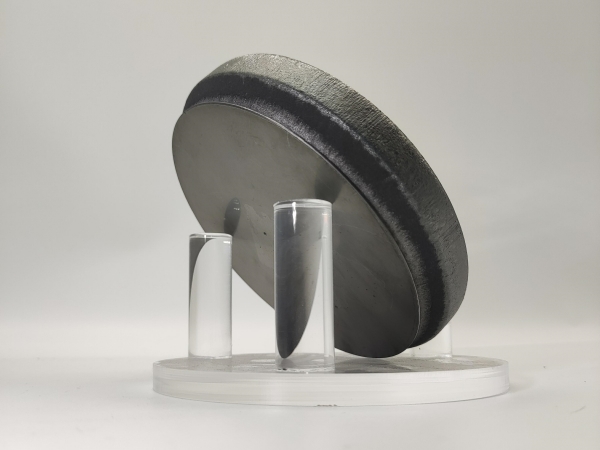
Sapphire wafers are monocrystalline α-alumina with a hexagonal close-packed lattice structure, ordered atomic arrangement, high hardness (Mohs 9) and strong thermal stability. Laser etching is much more difficult than that of glass wafers, relying mainly on the "cold processing" mechanism of ultrashort pulse (femtosecond, picosecond) lasers. Its core characteristics are:
1. Etching mechanism: Mainly based on physical sputtering. The laser energy is highly localized, and material removal is achieved by breaking the strong Al-O bonds inside sapphire, which requires avoiding crystal structure damage caused by high temperature; due to the anisotropy of sapphire, the etching effect is significantly affected by crystal orientation (such as C-plane and A-plane), so laser parameters need to be adjusted according to crystal orientation.
2. Processing effect: It can realize precision cutting, drilling and surface structuring with a small heat-affected zone, which can effectively reduce chipping and cracks; however, the etching rate is low, the surface roughness is difficult to reach the level of glass wafers, and the etching degree is not easy to control, which is prone to insufficient etching (residual material) or over-etching (wafer damage).
3. Process difficulty and cost: High requirements for laser equipment, requiring high-power ultrashort pulse lasers with high equipment cost; the adjustment of process parameters (pulse energy, frequency, scanning speed) is complex, which needs to match the sapphire crystal orientation, and the processing efficiency is low, mostly used for preliminary structuring processing in high-end scenarios.
4. Limitations: Poor etching selectivity and strict requirements on mask materials; it is difficult to achieve large-depth and high-uniformity etching, and the processing difficulty of complex microstructures is high, which usually needs to be used in conjunction with other processes.
II. Differences in Etching Processes
Etching processes are mainly divided into wet etching (chemical reagent reaction) and dry etching (plasma action). The differences in adaptability of the two processes on the two types of wafers stem from the chemical inertness and crystal structure of the materials, as follows:
(1) Differences in Wet Etching Processes
1. Wet Etching of Glass Wafers
Glass wafers have moderate chemical stability and are prone to chemical reactions with reagents such as hydrofluoric acid (HF) and potassium hydroxide (KOH). Wet etching has strong adaptability and is one of the commonly used processes for glass wafer processing. Its core characteristics are:
(1) Etching mechanism: Based on chemical dissolution reaction. HF solution can quickly react with silicon dioxide in glass to generate volatile SiF₄, with the reaction equation SiO₂+4HF→SiF₄↑+2H₂O; KOH solution reacts with silicon dioxide to generate potassium silicate, with the reaction equation SiO₂+2KOH→K₂SiO₃+H₂O. The two reagents focus on etching rate and processing perpendicularity respectively.
(2) Processing effect: HF solution has a fast etching rate, which can greatly save time cost, but poor anisotropy, prone to lateral undercutting, and the etching profile is arc-shaped; KOH solution has a gentle etching rate, not restricted by product saturation, good uniformity, and can prepare microstructures with higher perpendicularity, suitable for fine control.
(3) Process characteristics: Simple operation, low equipment requirements, low cost, easy for mass production; it can be combined with laser induction (LIDE technology) to improve etching selectivity through laser modification and achieve high-precision processing; however, HF solution is highly corrosive, harmful to human body and equipment, so the operating environment needs to be strictly controlled, and the resist is easy to fail in high-temperature etching solution, so special photoresist is required.
Sapphire wafers have extremely strong chemical inertness and high corrosion resistance to most strong acids and alkalis, so their adaptability to wet etching is extremely poor, and only limited etching can be achieved under specific conditions. Its core characteristics are:
(1) Etching mechanism: Special high-temperature and high-concentration etching solutions (such as high-temperature phosphoric acid and molten alkali) are required to achieve etching by breaking Al-O bonds. Conventional etching solutions (such as HF and KOH) have almost no effect on it at room temperature; in some scenarios, photoelectrochemical etching can be used to guide the etching path through conductors and improve selectivity.
(2) Processing effect: The etching rate is extremely low, and the uniformity is poor, making it difficult to achieve fine pattern transfer; the etching profile is difficult to control, prone to surface defects, which cannot meet the requirements of high-precision processing, and is only used for simple damage layer removal or rough processing.
(3) Process characteristics: Harsh process conditions (high-temperature and high-concentration etching solution), high operation risk and high cost; poor etching selectivity and strict requirements on mask materials; it is rarely used alone in actual industrial applications, mostly as an auxiliary process.
1. Dry Etching of Glass Wafers
The dry etching of glass wafers mainly adopts plasma etching, which is an auxiliary processing process, with core characteristics as follows:
(1) Etching mechanism: Use the glow discharge of specific gases (such as fluorine-containing gases) to generate plasma, which undergoes chemical reaction with the glass surface to generate volatile products and achieve material removal; it can be combined with physical bombardment to improve etching anisotropy.
(2) Processing effect: Higher etching precision than conventional wet etching and good sidewall smoothness, but low etching rate and complex process flow (needing to deposit aluminum layer as mask first, then photolithography and etching), high cost, only used for scenarios with high requirements on surface quality.
2. Dry Etching of Sapphire Wafers
The dry etching of sapphire wafers is mainly plasma etching (ICP/RIE), which is the mainstream process for its patterning. Its core characteristics are:
(1) Etching mechanism: Use high-density plasma of chlorine-based or boron-based chemical gases, combined with the comprehensive effect of physical bombardment and chemical etching to break Al-O bonds and achieve material removal; it needs to be carried out on a high-temperature stage (usually >100°C) to improve the etching rate.
(2) Processing effect: Good etching anisotropy, capable of achieving high-precision pattern transfer, effectively controlling the etching profile and reducing surface defects; however, the etching rate is still low, and long-time etching is prone to photoresist carbonization and residual impurities, affecting processing quality.
(3) Process characteristics: Complex equipment and high cost, requiring corrosion-resistant hard masks (such as metal nickel, chromium or silicon dioxide); the adjustment of process parameters is difficult, but compared with wet etching and laser etching, it is more suitable for mass and high-precision processing of sapphire wafers, and is widely used in high-end scenarios such as MEMS and GaN patterned substrates.
III. Summary of Core Differences and Comparison Table
The material properties of the two types of wafers (amorphous vs monocrystalline, chemical stability, hardness) determine the core differences in process adaptability. Based on the above analysis, the core difference comparison table is sorted out as follows for intuitive distinction:
| Comparison Dimension |
Glass Wafer |
Sapphire Wafer |
| Material Properties |
Amorphous, mainly composed of SiO₂, moderate chemical stability, low hardness |
Monocrystalline (α-alumina), extremely strong chemical inertness, high hardness (Mohs 9), with crystal orientation difference |
| Laser Etching Adaptability |
High adaptability, commonly used ultrafast laser direct etching and LIDE technology, simple process |
Moderate adaptability, only suitable for "cold processing" with ultrashort pulse laser, high difficulty and cost |
| Wet Etching Adaptability |
Strong adaptability, commonly used HF and KOH solutions, fast rate, low cost, mainstream process |
Extremely poor adaptability, only achievable with high-temperature special etching solution, mostly used for auxiliary rough processing |
| Dry Etching Adaptability |
Moderate adaptability, plasma etching as auxiliary process for high-end surface needs |
Strong adaptability, ICP/RIE etching as mainstream process, capable of high-precision patterning |
| Core Processing Combination |
Laser induction (LIDE) + wet etching, high efficiency and precision |
Ultrashort pulse laser + high-density plasma etching, overcoming the problems of high hardness and high inertness |
| Process Cost and Efficiency |
Low cost, high efficiency, suitable for mass production |
High cost, low efficiency, focusing on high-end application scenarios |
1. Glass wafers: Laser etching (especially LIDE technology) and wet etching have strong adaptability, with simple process, low cost and high efficiency, which can realize high-precision and complex microstructured processing and are the mainstream processing methods; dry plasma etching is only used as an auxiliary process for high-end surface quality requirements.
2. Sapphire wafers: Ultrashort pulse laser etching and dry plasma etching are the main processing methods; the former is used for precision cutting and preliminary structuring, and the latter for high-precision patterning; wet etching has extremely poor adaptability and is only used as an auxiliary process; the overall process is high in difficulty, cost and low in efficiency, focusing on high-end application scenarios.
3. Key differences: Glass wafers rely on the combined process of laser induction + wet etching to achieve high-efficiency and high-precision processing; sapphire wafers rely on ultrashort pulse lasers and high-density plasma etching to overcome the problems of high hardness and high chemical inertness; the former has low process cost and good batch adaptability, while the latter has high process threshold and focuses on high-end needs.
To meet the application needs of the above two types of wafers, Jingmu Optoelectronics can supply 1-12 inch sapphire substrates and quartz glass wafers. The thickness and crystal orientation of the products can be customized according to customers' specific processing needs, adapting to various processing processes such as laser etching and corrosion, and meeting the application needs in different scenarios.